
best practices guide for F/HWD testing
F/HWD device selection, setup, and testing procedures for highways and airfields
| Item | Requirement |
|---|---|
| 🔍 Falling/Heavy Weight Deflectometer (F/HWD) | |
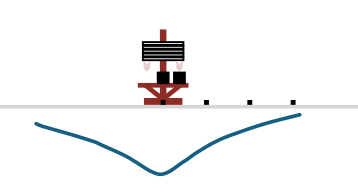
| F/HWD device | Dynatest, SWECO, or a comparable device (validated by simultaneous testing at the same locations with a reliable device and a comprehensive review of load/deflection time histories). |
| Reference calibration | Within 1 year of test date. |
| Relative calibration | Within 1 month of test date. |
| Maintenance records | Well maintained — records to be provided at least 1 month before testing. |
| 🔩 F/HWD Setup | |
| F/HWD plate | Small plate (300 mm diameter) for highways; large plate (450 mm diameter) for airports. |
| Geophones positions | 7 geophones (0, 12, 18, 24, 36, 48, 60 in) or preferably 9 geophones
(0, 8, 12, 18, 24, 36, 48, 60, 72 in).
Remove 8-inch geophone with large plate. Metric: 7 geophones (0, 300, 450, 600, 900, 1200, 1500 mm) or preferably 9 geophones (0, 200, 300, 450, 600, 900, 1200, 1500, 1800 mm). Remove 200 mm geophone with large plate. |
| Joint load transfer efficiency (PCC) | Place two geophones on the same side of the plate (behind or to the side), with the joint positioned between them; e.g., geophones at 8 and 12 inches with the joint at 10 inches. |
| Time histories | Collect for all drops, minimum 60 msec. |
| Smoothing | Off (may be on for certain devices like Dynatest F/HWD, as it does not affect recorded time histories). |
| Distance measurement instrument (DMI) | Yes. |
| Air and pavement surface temperatures | Yes. |
| GPS coordinates | Yes (submeter accurate). |
| 🚧 F/HWD Testing Procedure | |
| Warm-up drops | Yes (refer to LTPP data collection manual). |
| Seating drop(s) | One or two at third highest drop, unrecorded. |
| Load levels | Drops at heights 1, 2, 3, and 4, corresponding to 6, 9, 12, and 16 kips or 25, 40, 55, and 70 kN (±10%) for highways; for airfields, drop height 3 or 4 should match the wheel load of the design aircraft. |
| Drops per load level | One, preferably two. |
| Points per location | One, preferably two points spaced 5 ft (or 2 m) apart at selected locations. |
| Time of testing | Flexible pavements: Day or night. Rigid pavements: Night or early morning. |
| Repeat testing | Yes for flexible pavements — morning and afternoon (not necessarily same day). |
| Mark locations for retesting in the future | Yes — for repeat testing and for monitoring pavement damage and aging through retesting at 2–4 year intervals (2 years for flexible pavements, 4 years for rigid pavements). |
| Transverse location | Highways: Outer wheel path, 75 cm ±10% from the outside lane edge to the plate center for flexible pavements. Airports: Adjust to match gear locations for flexible pavements. Rigid pavements: Test at the center of slabs and at joints. |
| Surface condition & shading | Record as Dry, Damp, or Wet; note if area is Shaded. |
| Pavement condition images | Collect every 25 ft/5–10 m or less, if testing is performed during daytime. Images can be collected during the day by driving pavement if F/HWD testing is performed at night. |
| 📊 Data Review Before Project | |
| Data review | Provide a sample F/HWD data file with project setup at least one week before the project by testing 1–2 points. |
