
case study summary
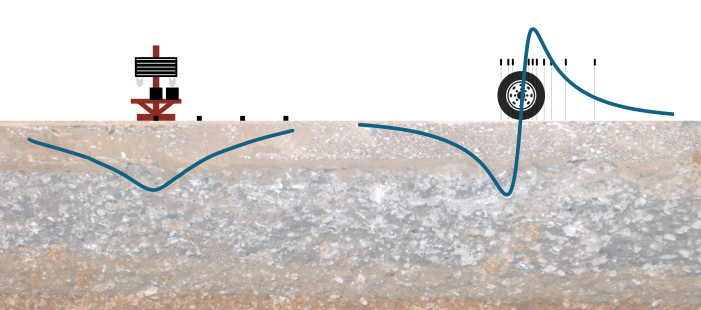
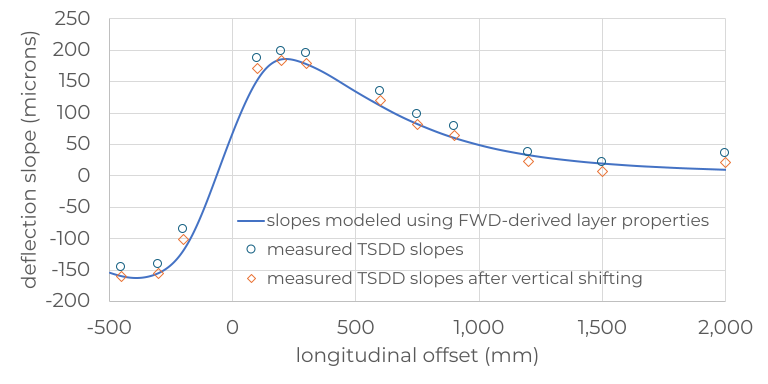
This case study analyzes data collected using a Falling Weight Deflectometer (FWD) and a Traffic Speed Deflection Device (TSDD) equipped with Doppler lasers on a flexible pavement section at the duraBASt facility in Germany. Nonlinear dynamic backcalculation is performed using the FWD data, resulting in a high subgrade modulus. Although the subgrade was initially assumed to be weak, subsequent information from BASt indicated that it was lime-stabilized; a condition not known a priori to pulsuus and consistent with the elevated modulus obtained. Modeling is then performed using the FWD-derived properties to simulate the moving TSDD, and the calculated deflection slopes are found to be lower than the measured slopes, a discrepancy attributed to the incorrect zero-slope assumption used by the TSDD. After adjusting the slopes using a well-established procedure, a one-to-one agreement is observed between the layer moduli backcalculated from the FWD and TSDD, despite differences in their respective measurement principles.
case study insights
FWD and TSDD testing were conducted in 2023 at the duraBASt facility located east of Cologne, Germany. duraBASt is a research facility comprising multiple flexible and rigid pavement sections and is owned and operated by the German Federal Highway and Transport Research Institute (BASt).
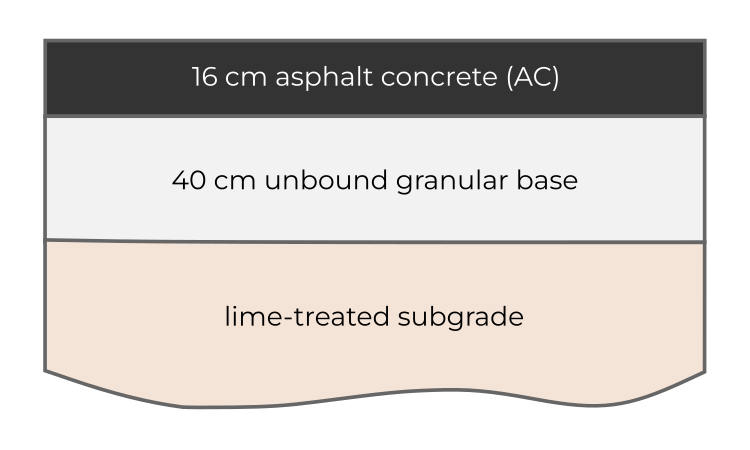
This case study focuses on the straight flexible pavement section with a total asphalt concrete thickness of 16 cm and an aggregate base thickness of 40 cm.
TSDD testing was carried out on March 13 using the Measure Road deflectometer, and FWD testing was subsequently performed on March 17 using a SWECO device. The TSDD deflection slopes were collected at a frequency of 1 kHz and reported at 1 m intervals, while FWD testing was performed at 5 m intervals.
normalized deflections
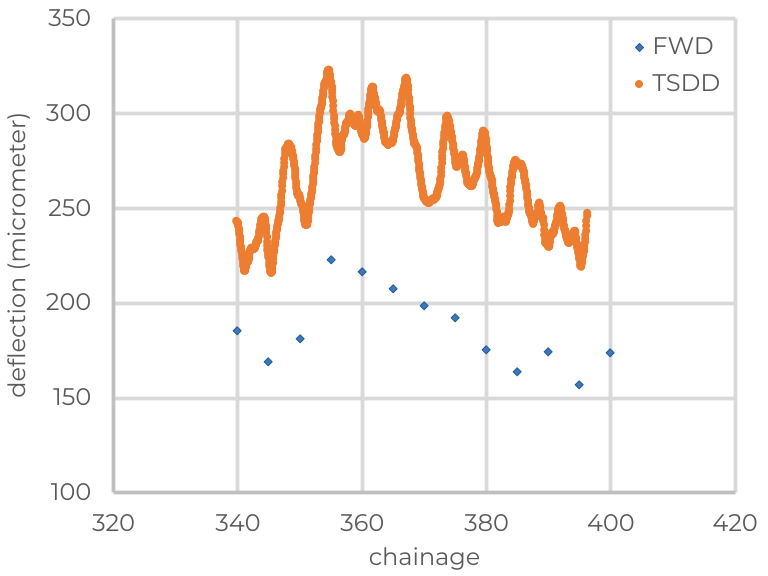
The TSDD deflections are recalculated using the new Measure Road continuous integration technique and are reported at 5 cm intervals. As shown, the center deflections exhibit considerable variability despite the relatively short length of the test section. This variability reflects true pavement variability rather than measurement noise, as comparable patterns are observed across the eight TSDD replicates collected in both testing directions.
A comparison of TSDD and FWD center deflections reveals differences in deflection magnitudes, although the overall trends remain similar.
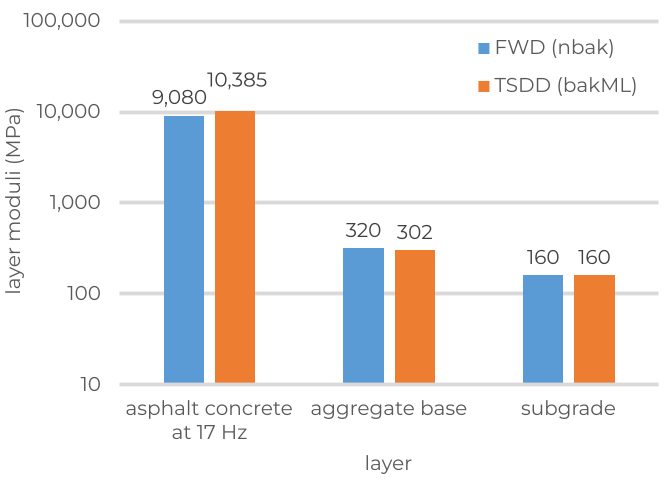
FWD (nbak) vs. TSDD (bakML) backcalculation
Moving-load backcalculation is then performed using bakML after applying a vertical shift to correct the zero-slope assumption, and the resulting layer moduli are found to be comparable to those obtained from nonlinear dynamic backcalculation of the FWD data.
It is important to note that the asphalt concrete temperature during FWD testing was measured manually near the surface and reported as 15.9°C. In contrast, no temperature measurements were made during TSDD testing; however, a review of air temperature patterns before and during testing indicates that the asphalt concrete layer temperatures are likely comparable.
If the measured TSDD slopes had not been shifted downward, the backcalculated subgrade moduli for the two locations would have been approximately 25 to 42% lower and the base moduli 11 to 36% higher. The effect of the shifting is smallest for the asphalt concrete layer, with differences of only 3 to 10%.
segmentation using change point detection
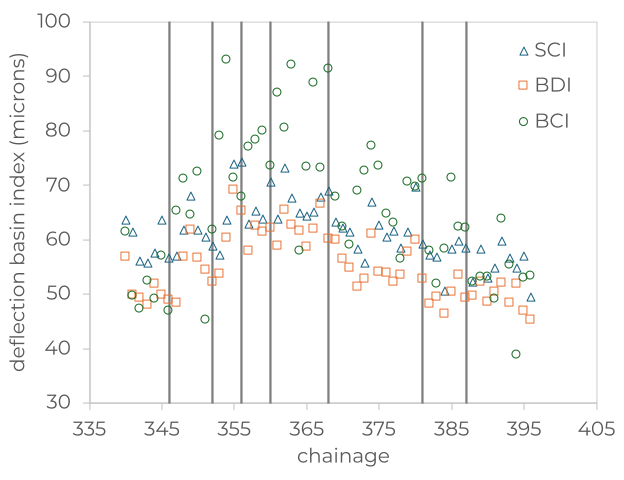
Furthermore, the section is subdivided into eight uniform segments using the change point detection method by considering several deflection basin indices calculated using the TSDD deflections. These indices include the Surface Curvature Index (SCI), Base Damage Index (BDI), and Base Curvature Index (BCI). Typically, the segmentation includes the layer thicknesses and types, but these variables are assumed to be constant for that section.
It is clear from the figure that the section is non-uniform mainly due to changes in the subgrade properties, as reflected by the BCI.
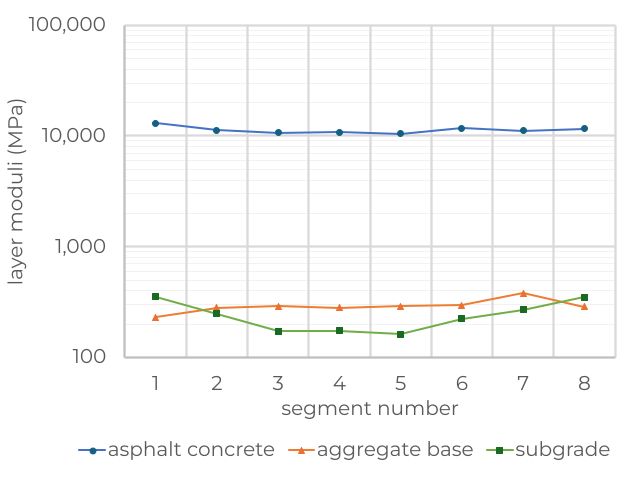
backcalculation for all segments
Backcalculation is then performed using bakML for the eight segments after accounting for the vertical shifts in the measured slopes. The subgrade layer moduli are shown to exhibit spatial variability with an average value of 235 MPa; such variability is typical of lime-stabilized subgrades and reflects natural soil variability, differences in lime reactivity, and construction factors such as mixing uniformity and moisture control. The aggregate base layer moduli are consistent for a high-quality crushed aggregate base, with an average of approximately 290 MPa, while the asphalt concrete moduli are the most uniform, averaging about 11,300 MPa.
