case study summary
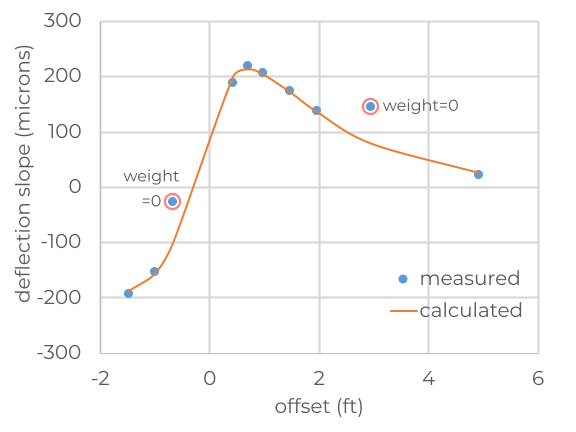
Traffic Speed Deflection Device (TSDD) and Falling Weight Deflectometer (FWD) testing were conducted on a flexible pavement in Denmark. The purpose of this case study is to conduct an in-depth investigation comparing the responses measured by both devices. The FWD deflections are shown to be uniform for the evaluated segment, while the TSDD deflection slopes and deflections are shown to be noisy when reported at 1 m intervals, but sensitive to temperature and spatial variations. Nonlinear dynamic backcalculation is performed and the resulting layer properties are used in a three-dimensional (3D) finite element (FE) model to simulate the TSDD’s moving dual wheel load. Acceptable, though not ideal, matching is achieved between the calculated and TSDD-measured deflection slopes, with multiple outliers identified.
case study insights
TSDD testing was conducted on June 13, 2023, over a 33-mile loop near Copenhagen, Denmark. The TSDD testing was performed in three replicates. In addition, FWD testing was performed on three sections along this loop, each ranging in length from 0.25 to 0.30-mile (400 to 500 m), using a SWECO PRIMAX 1500 device. A 250 m flexible pavement segment is selected in this study to conduct an in-depth investigation comparing the responses measured by the TSDD and FWD.
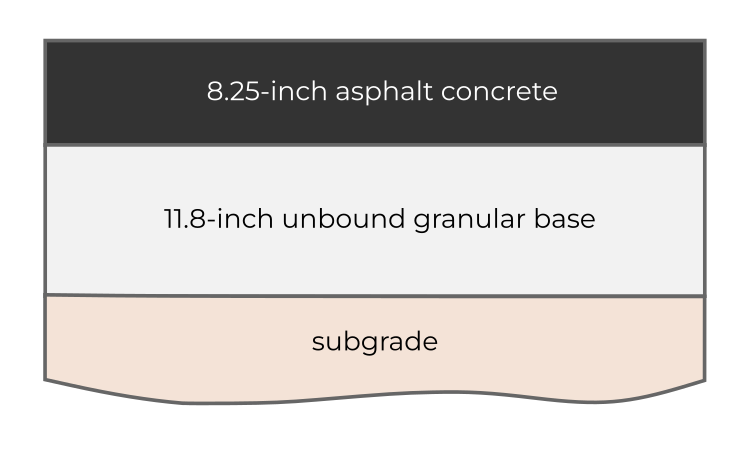
The asphalt concrete layer thickness is determined through coring, while the aggregate base layer thickness is determined through the review of the construction records.
normalized deflections
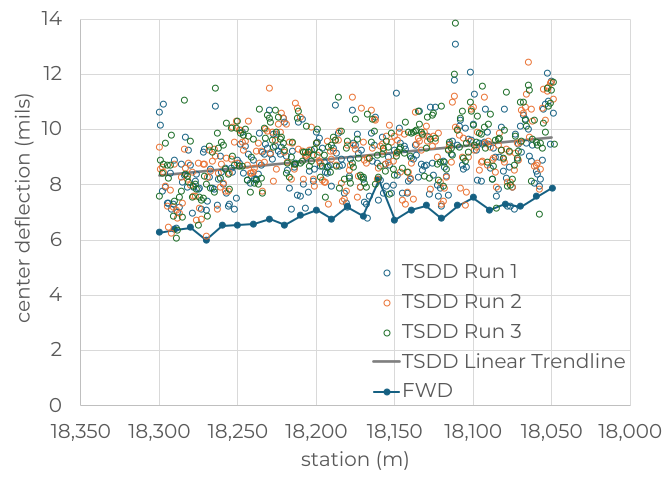
The TSDD deflections for the three runs are reported at 1 m intervals, whereas the FWD testing is performed at 10 m intervals. A linear trendline is fitted through the TSDD data by considering the three runs to highlight the underlying trend in the deflection response.
Four general observations are made:
- The TSDD deflections exhibit considerable noise when reported at 1 m intervals. Aggregating the data to standard network- or project-level reporting intervals would significantly reduce or eliminate this noise. In contrast, the FWD deflections are relatively uniform.
- Both devices show a similar increasing trend in deflections from the beginning to the end of the segment.
- Differences exist in the magnitudes of the measured deflections; however, direct comparison is not appropriate due to differences in loading mechanisms and measurement principles between the two devices.
- The FWD captures a localized area of relatively high deflection in the middle of the segment, which is not identified by the TSDD.
moving load modeling
Moving-load modeling is conducted using 3moD, a pulsuus application that employs 3D FE analysis to model the TSDD moving dual-wheel load and compute pavement responses. Alternatively, the analysis can be performed using bakML, which is more efficient than 3moD.
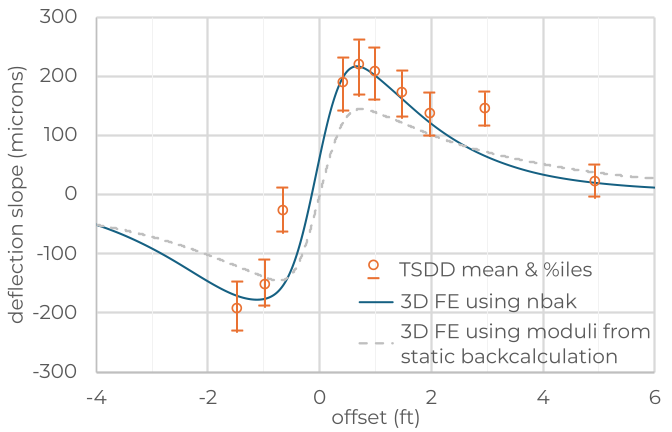
The deflection slopes are calculated using the layer properties generated by nbak as input (blue solid line). The slopes measured by the TSDD are shown in orange, along with the 5th and 95th percentiles to illustrate measurement variability. Acceptable agreement is obtained between the measured and calculated slopes using the properties from nbak, despite the presence of two outliers at −0.66 ft (−200 mm) and 2.95 ft (900 mm).
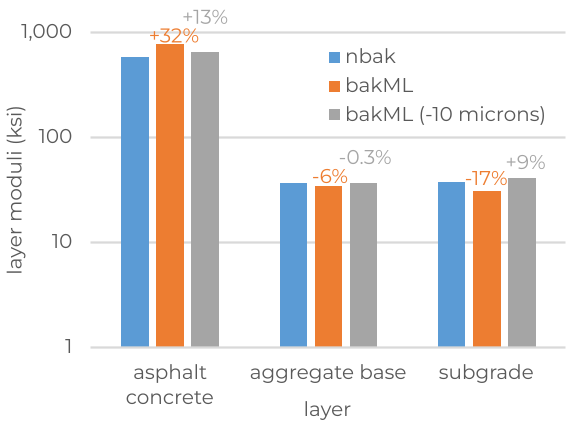
In addition, the modeling is repeated using the layer moduli obtained from static backcalculation, and the corresponding slopes are reported (gray dotted line). None of the measured slopes are shown to fall on the gray dotted line, which confirms the earlier findings regarding discrepancies in the backcalculated layer moduli.