overview
The Surface Cracking Life (SCL) and Pavement Deformation Life (PDL) are TSDD network-level metrics derived from Traffic Speed Deflection Device (TSDD) measurements to estimate the remaining life, in years, for surface cracking and permanent deformation in unbound layers, respectively. These metrics proactively quantify the overall structural capacity of flexible pavements, providing an early indication of potential weaknesses. When distress data is available, it can be incorporated as an additional factor to further prioritize segments for project-level evaluation, combining both proactive and reactive insights. In contrast, existing procedures based on the effective structural number (SNeff) and the required structural number (SNreq) as indicators of structural capacity for in-service pavements primarily focus on protecting the subgrade, assuming that subgrade layer moduli are reliably determined, and do not fully account for the structural capacity of the surface and intermediate layers. The SCL and PDL approach eliminates the need for adjustment or correction factors for subgrade layer moduli and avoids reliance on decision trees or empirical selection procedures. In addition, these metrics provide results expressed directly in years of remaining life, rather than in deflection units or structural-number ratios, offering a simple mechanistic and meaningful framework that can be readily implemented in practice.
mechanistic-empirical metrics
SCL and PDL:
- Follow the classical mechanistic–empirical pavement design procedure to capture the full picture of pavement behavior by considering surface layer cracking and permanent deformation in unbound layers.
- SCL detects structural inadequacies in the asphalt concrete layer, the base layer, or a combination of the two, while PDL captures inadequacies in the subgrade or the overall pavement structure when it fails to protect the subgrade layer.
- Are adjusted to a reference axle load.
- Can be adjusted to a reference pavement temperature and reference TSDD speed.
- Can be calibrated based on existing pavement conditions.
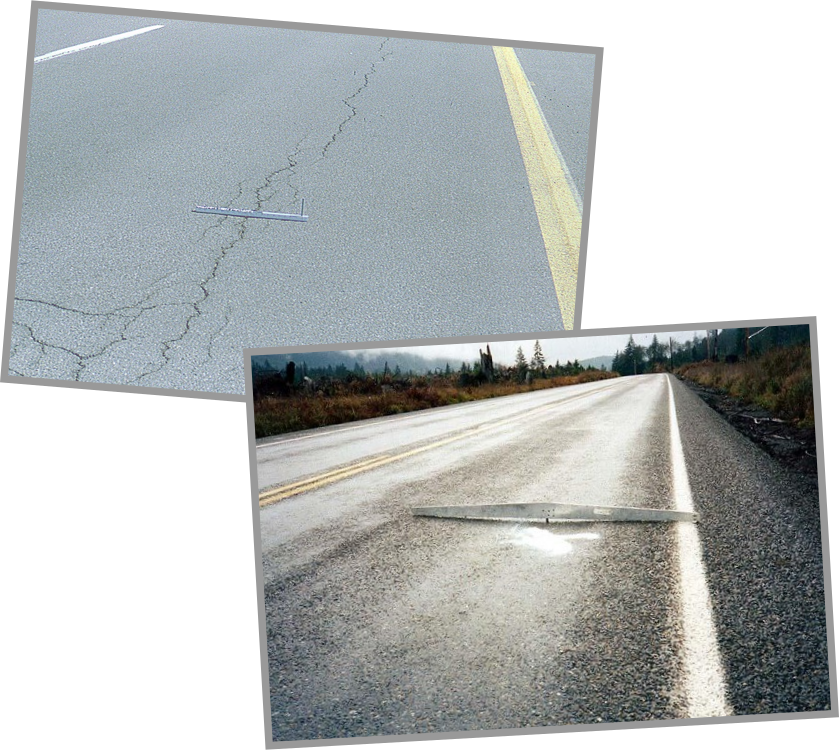
In addition, SCL and PDL are considered proactive metrics, as opposed to reactive ones, because they can indicate potential structural weaknesses before visible distress—such as cracking or permanent deformation—appears at the pavement surface. By identifying structurally vulnerable locations early, these metrics help agencies plan and implement preventive maintenance strategies at the appropriate time, preserving pavement structural integrity and ride quality. This proactive approach improves user comfort and safety, reduces the risk of accelerated deterioration, and helps avoid more costly rehabilitation or reconstruction later.
Finally, SCL and PDL can be calculated at a small—or optimal—TSDD reporting interval, allowing agencies to:
- Identify localized areas of potential failure that may require remove-and-replace (R&R) treatments.
- Define the limits of pavement sections that warrant detailed project-level evaluation.